
In short
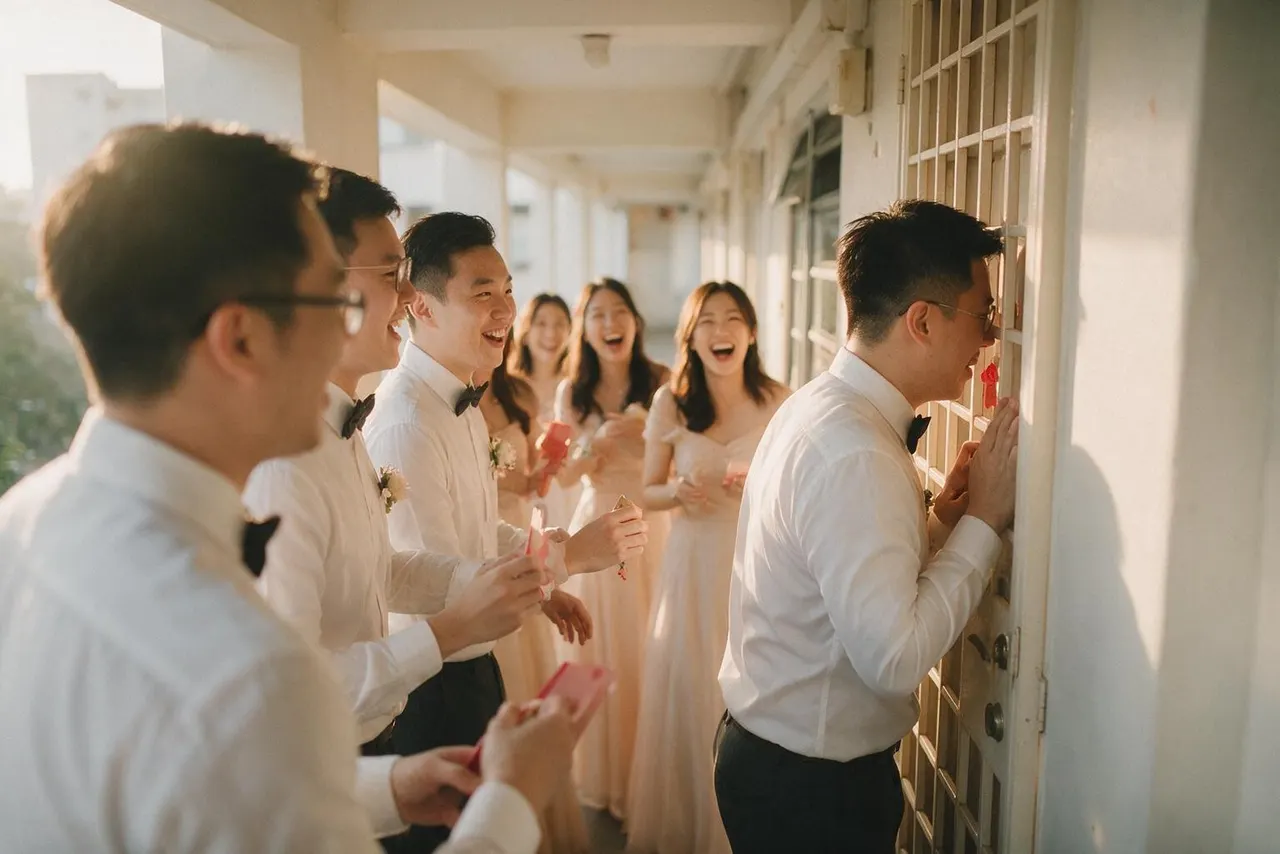
During gatecrash, a photographer working in a documentary style positions to capture the room as a whole, not only the games themselves, since guest reactions, laughter and tension often produce more memorable images than the games alone. This means watching the crowd as much as the doorway throughout the segment.
- Guest reactions during gatecrash often make stronger images than the games themselves.
- Positioning for the whole room matters as much as positioning at the doorway.
- Knowing which guests are likely to be expressive helps a photographer anticipate moments.
- Candid coverage works alongside, not instead of, photos of the planned games.
- Gatecrash unfolds as a sequence of small moments rather than one single scene.
Why guest reactions often make the best gatecrash photos
The door games and gatecrash segment seen at many Chinese wedding day celebrations in Singapore are designed to be lighthearted and a little chaotic, which naturally produces genuine, unposed reactions from the guests watching. Laughter, groans, and friends egging each other on often carry more energy than the games themselves.
A photographer focused only on the groomsmen completing each challenge can miss this surrounding energy entirely, ending up with a technically fine sequence of the games but little sense of the atmosphere in the room.
Couples who want the fuller picture of what gatecrash really felt like should mention this preference to their photographer beforehand, since it changes where attention is placed throughout the segment.
Positioning for the room, not just the games themselves
Covering gatecrash well often means alternating between two vantage points: close enough to the doorway to capture the games clearly, and wide enough to take in the guests reacting nearby. Some photographers move between these positions throughout the segment rather than settling in one spot.
Where a second shooter is available, one crew member can hold a wider position dedicated to guest reactions while the other follows the games more closely, giving fuller coverage of both without either being sacrificed.
Because gatecrash tends to move around, from the doorway into the corridor or living room and back, staying aware of where guests are gathering matters as much as tracking the games' progress.
How gatecrash unfolds as a sequence of small moments
Rather than one continuous scene, gatecrash is really a series of short moments strung together: a challenge beginning, guests reacting, a brief pause, then the next challenge. Recognising this rhythm helps a photographer anticipate when to watch the doorway and when to watch the crowd.
Some of the strongest images come from the brief gaps between challenges, when guests relax for a moment and reactions become more natural rather than performed for an ongoing game.
A photographer who treats the segment as a single block of time, rather than this sequence of smaller moments, is more likely to miss these in-between beats.
Briefing your photographer on which guests to watch for
If certain friends or family members are known for being particularly expressive or involved in planning the games, mentioning this to your photographer beforehand gives them a head start on where to look. This is especially useful in a room full of unfamiliar faces, where a photographer has no other way to know who to watch.
It also helps to mention roughly how many challenges are planned and where they will take place, since this affects how the crew positions themselves across the space.
A short briefing along these lines tends to produce noticeably fuller coverage than leaving the photographer to work it out entirely on the spot.
Balancing candid reaction shots with the planned game shots
Candid guest reactions add atmosphere, but the games themselves are still part of what couples usually want documented, since they are often planned in advance with real effort from the wedding party. The aim is coverage of both, not one at the expense of the other.
A photographer balancing this usually leans toward the games during each challenge itself, then shifts attention to the crowd during pauses and reactions, rather than trying to hold both in frame at once.
Reviewing your gallery afterward, you should be able to see both what the games looked like and how the room responded to them, rather than only one or the other.
What this looks like when it works well
When gatecrash coverage balances games and reactions well, the resulting photos tell a fuller story of the segment than a straightforward record of each challenge alone. Guests often recognise themselves in these images more readily than in posed group shots, since the moments are unguarded.
This kind of coverage also tends to sit well alongside video from the same segment, since a videographer following the same room-wide approach can capture the sound and movement that stills alone cannot.
- Mention if you want more emphasis on guest reactions than on the games.
- Share roughly how many challenges are planned and where.
- Point out any guests known for being especially expressive.
- Ask how your photographer plans to balance both aspects of the segment.
If you want gatecrash covered with more emphasis on guest reactions, get in touch and let us know before the day.