
In short
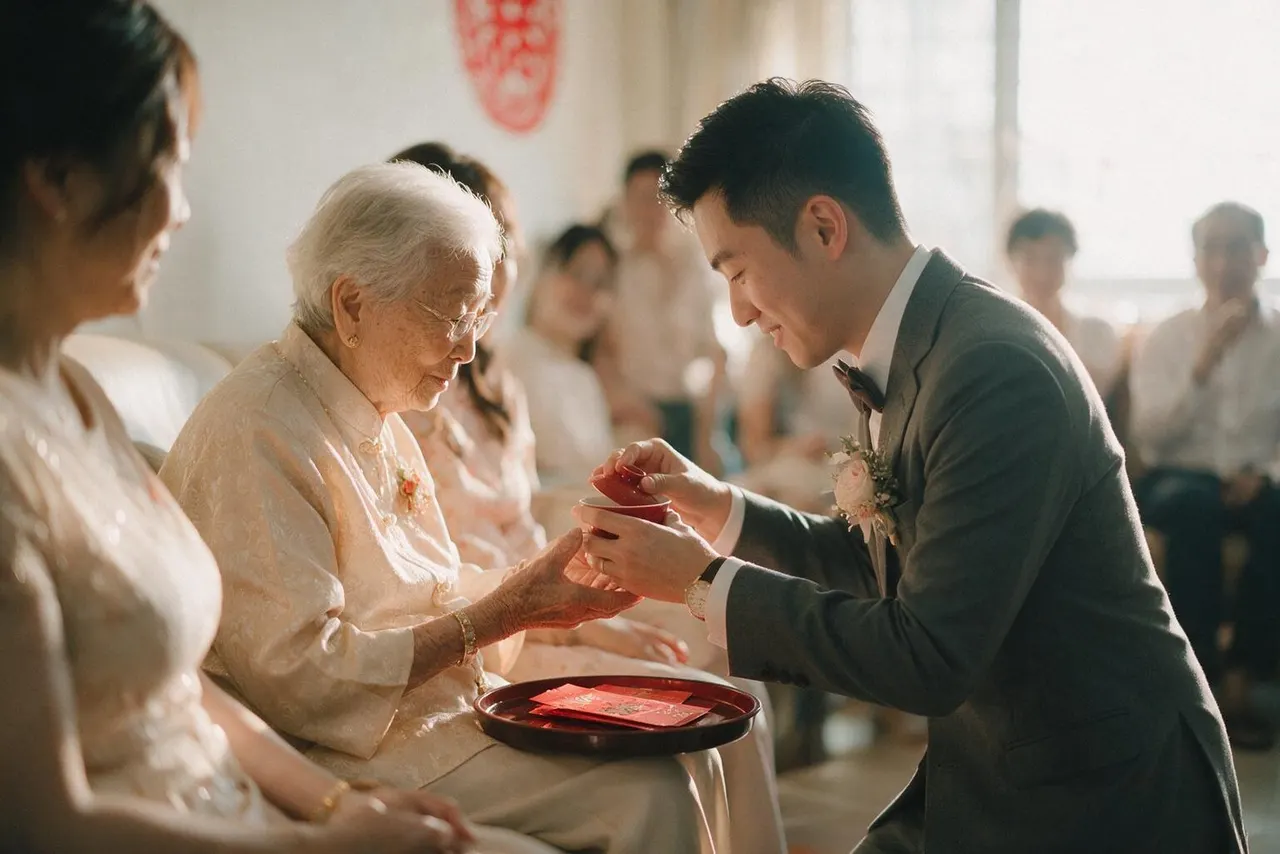
The tea ceremony is the point in a Chinese wedding day when the couple formally serves tea to their parents and elders, and is welcomed into the family in return. It usually happens at the family homes after the gatecrash, follows a serving order based on seniority, and the details vary by family and, in places, by dialect group.
- The ceremony marks respect for elders and, at the groom’s side, the bride’s acceptance into his family; couples traditionally perform three bows beforehand, to heaven and earth, to parents, and to each other
- It is traditionally held twice on the wedding day: first at the groom’s home, then at the bride’s, with tea offered to any household deities and ancestors before the living relatives are served
- Tea goes to the groom’s parents first, then to senior members of the family and other relatives, and each person served gives the couple a red packet or jewellery
- Some customs around the wider wedding, such as betrothal gifts and jewellery, have traditionally differed between dialect groups
- If two sittings are hard to fit into the day, agree with both families what you will keep and what could be simplified
- Sharing the seating plan and serving order with your photographer in advance helps them capture each moment without stepping into the family’s space
What the tea ceremony means, and why families hold it
Chinese wedding customs are, in the National Heritage Board’s description, “rich in meaning and symbolism”, and the tea ceremony is where much of that meaning is made visible. The couple kneels or bows before each elder in turn, serves them tea, and receives blessings in return, an unhurried exchange of respect that stands apart from the rest of the wedding day.
According to the National Library Board, couples traditionally perform three bows before tea is served: the first to heaven and earth, the second to parents, and the third to each other, after which, in customary terms, the tea ceremony marks them as husband and wife. The legal marriage is the solemnisation registered with the Registry of Marriages; see our guide to ROM in Singapore. At the groom’s home, the ceremony also signifies the bride’s acceptance into his family. More broadly, it gives the couple a chance to show gratitude to both sets of parents, who respond with blessings and good wishes of their own.
When and where it happens on the day
The tea ceremony usually takes place on the wedding day itself, after the gatecrash at the bride’s home, where the groom and his groomsmen complete a series of tasks set by the bride’s friends before he is allowed in to see her. The couple then leave together, and the first sitting is held at the groom’s home.
At the groom’s home. Where the family worships deities and ancestors at home, the couple prays at the family altar first, before tea is served to the living relatives, starting with the groom’s parents.
At the bride’s home. The couple then travel to the bride’s home, where she typically changes into a kua beforehand, to hold a separate sitting for her own family. Infopedia describes the return visit as taking place three days after the wedding in the past and on the wedding day itself today; consider allocating a separate block for the tea ceremony in your wedding day timeline.
What to prepare: tea, tray and who pours
The tea itself is traditionally brewed with lotus seeds, red dates and longans, said to symbolise a sweet and fertile marriage, and served in cups set out on a red tray. A female relative usually keeps the cups topped up as each round is served, so the couple can concentrate on greeting each relative rather than managing the teapot.
Elders are usually seated while the couple kneels before them and offers the cup with both hands, though some couples choose to bow rather than kneel. Either way, check with the family beforehand, and have something comfortable to kneel or bow on ready if there will be several rounds. Some families also prepare the marital bed in a separate, earlier custom known as an chuang; that ritual is not part of the tea ceremony and takes place three days to a week before the wedding.
The serving order: generation and seniority
Where a family worships at home, tea is offered first to the gods and then to the groom’s ancestors, to seek their blessing before any living relative is served. It then goes to the groom’s parents, followed by senior members of the family and other relatives. Ask your family who should be served after the parents and in what order.
The direction can also reverse: the groom’s younger siblings may offer tea to the couple, and the couple may also serve tea to each other, in a gesture said to symbolise mutual trust and goodwill. Ask whoever is coordinating the ceremony to write out the order beforehand; it tells you how many rounds to expect and how many red packet or jewellery moments there will be to plan around.
Who sits where
Infopedia describes those being served as usually seated; confirm how many chairs your family needs and where other relatives will wait. In a smaller flat or hotel room, this can mean a tight cluster of chairs with limited space to move.
Share a rough seating plan with your photographer and discuss positions for covering the serving without moving between relatives. It also helps to know which relatives are seated together, since a photographer working blind may not realise that two elders side by side are, say, a grandmother and a great-aunt who rarely appear in the same frame otherwise.
What elders commonly give: red packets and jewellery
Infopedia records that everyone served tea gives the couple a red packet or jewellery; ask your family where these gifts should be placed. Heritage records of Singapore weddings from the 1960s describe the same exchange. Our guide to red packet etiquette covers how families handle the giving and receiving.
If jewellery will be given, ask the family whether they would like it put on during the ceremony, so your photographer can be ready for it. Brief your photographer on any planned gift handovers and discuss where they should stand to photograph them. Discuss whether a second angle would help cover the giver’s face and the receiver’s reaction.
How customs vary: by dialect group and by family
The National Heritage Board describes Chinese wedding customs as helping to reinforce the ethnic identity of participants, “especially that of dialect groups since each group has its distinct wedding practices.” The dialect differences these sources describe mostly concern the betrothal gift-giving (guo da li) and the days before the wedding, rather than the tea ceremony itself. Teochew betrothal gifts have traditionally included peanut-and-sesame candy, while Cantonese gifts have traditionally featured items such as dried seafood; the jewellery given to the bride at this stage has traditionally been a pair of dragon-and-phoenix bangles for Cantonese families or four gold pieces (si dian jin) for Teochew families. Infopedia describes the hair-combing ritual as traditionally Cantonese and also practised by other dialect groups in Singapore, while Roots quotes wedding planner Rubina Tiyu explaining that Teochews believe the bride should leave home before sunrise and therefore hold the gatecrash very early in the morning.
The heritage sources above describe the tea ceremony itself in general terms: serving by seniority, tea with symbolic ingredients, and a hongbao or jewellery in return. Rather than assume a particular custom because of a family’s dialect group, it is simplest to ask directly what that family does.
Two ceremonies, two families
If you are holding a ceremony for each family, confirm the seating, serving order and any requested customs with each side separately. It is worth confirming with both families separately rather than assuming the second ceremony will mirror the first, since dialect group, religion or simply family preference can change the details from one home to the other.
This also affects planning for the day as a whole. If both ceremonies happen in the same morning, travel time between the two homes needs to be accounted for, and your photographer and videographer will need a quick briefing on what has changed: different seating, a different serving order, or additional relatives who were not present at the first ceremony.
If you want to simplify the ceremony
The National Heritage Board notes that modernisation, busy schedules and budget constraints have led some families to simplify certain wedding rituals. If two sittings in two homes are hard to fit into your day, talk to both families early about what could change: for example, whether a single sitting would be acceptable, whether it could be held where the wedding party is getting ready, or whether it could be kept to a smaller group of relatives.
These are options to discuss rather than a standard practice, and none is more correct than another. Keep what matters to your families, and let your photographer know the final plan so they can prepare for the room and the order.
Tight rooms and mixed light
Before the ceremony, ask your photographer to assess the room, seating and available light. Discuss whether additional lighting would leave enough space for your family, and agree on suitable camera positions beforehand.
If the room is genuinely too tight or dim to work in comfortably, it is reasonable for your photographer to ask, politely, whether a chair can be shifted slightly or a curtain opened, but this should be a quick, low-disruption request rather than a pause in the ceremony.
Group photos afterwards
The end of the ceremony is a natural moment for a formal group photo with the couple, and sometimes one with the wider family before people disperse. Individual photos with parents or grandparents, or specific pairings such as grandparents together or siblings together, are easy to forget once the room starts moving again.
Asking in advance which group combinations matter to the family saves scrambling to reassemble people afterwards.
How a photographer and videographer share the space without blocking family
If two crew members will cover the ceremony in a small room, discuss their positions with your family beforehand. Consider asking the photographer to cover the serving and exchange from a closer position, while the videographer takes a wider view of the room and relatives’ reactions.
Ask both crew members to confirm where relatives will watch from, keep those areas clear and avoid crossing your sightline during the exchange. Agree rough positions beforehand and ask the crew to leave clear views for relatives watching or taking photographs.
Use the sources above as a starting point, and ask your family which customs they wish to observe. If you would like to talk through your own family’s plans, check your date with us, or read more about our actual-day wedding photography.