
In short
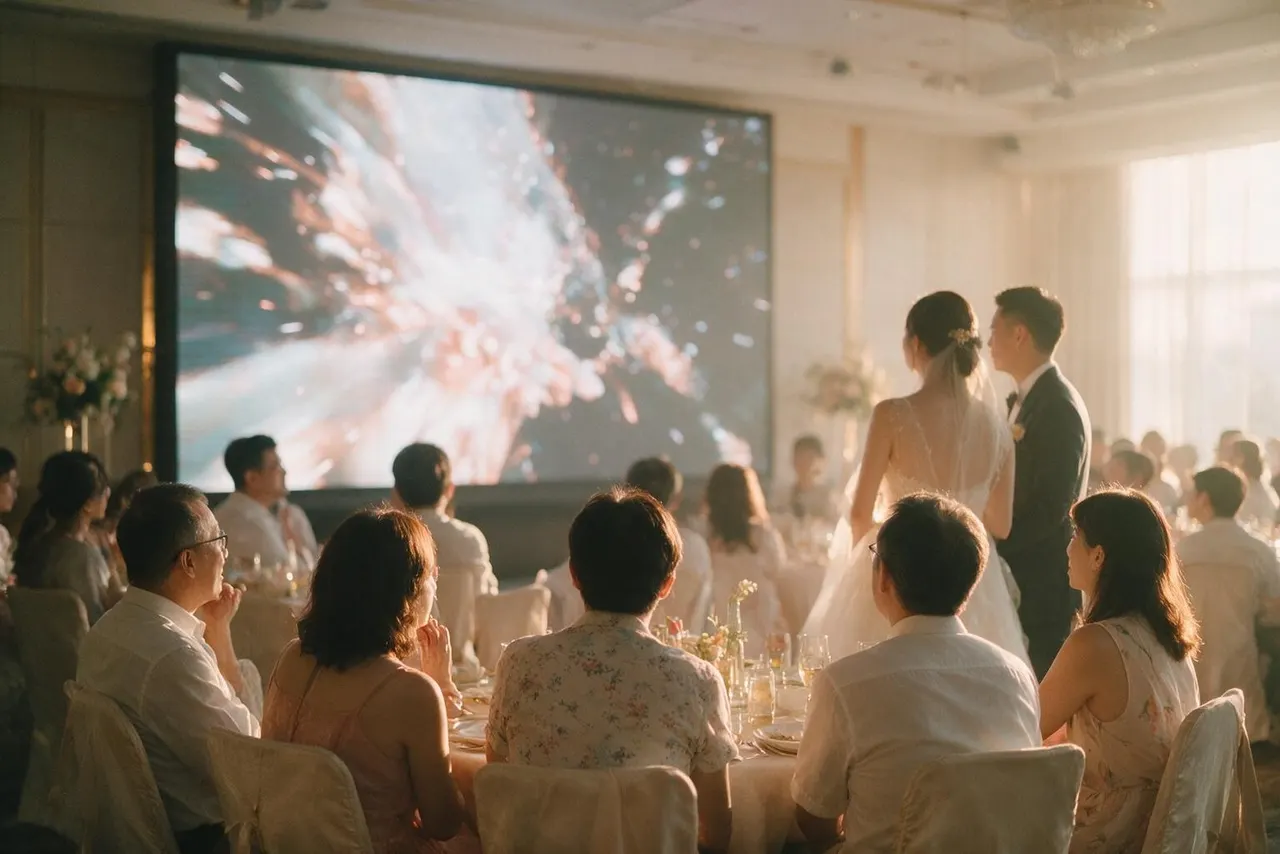
A same day edit screening generally needs a screen sized for the room, a projector or display bright enough for the banquet's lighting, and clear audio reaching every table. The exact setup depends on your venue and room layout, so these details are best confirmed with your videography team and venue well before the day.
- Screen size should be judged against the room's dimensions and how far the furthest tables sit from it.
- Projector brightness matters more in a banquet hall with ambient lighting than in a fully darkened room.
- Audio for the screening needs to reach every table clearly, not just those nearest the screen.
- Some venues have their own AV equipment while others expect vendors to bring their own, so this needs checking.
- Confirm screen, projector and audio details with your venue and videography team well ahead of the banquet.
Screen size and placement considerations for the ballroom
The right screen size for a same day edit screening depends largely on the size of the room and how far guests are seated from the screen, rather than a single figure that works for every venue. A screen that reads clearly to guests at the front tables may be too small for those seated further back, so it is worth thinking about sightlines across the whole room, not just the tables closest to the stage.
Placement matters as well as size. A screen positioned where it competes with stage lighting, a live band setup, or a walkway used for the march-in can end up harder to see than one placed with those elements in mind. Walking through the room layout with your venue and videography team ahead of time helps avoid a screen position that looks fine on paper but does not work once the room is set for the banquet.
Projector brightness needed for a banquet setting
Banquet halls are rarely fully darkened during a screening, since tables still need enough light for guests to see their food and each other, which means the projector or display needs to be bright enough to stay clear against that ambient light. A setup that would look sharp in a dark cinema can appear washed out in a lit ballroom if brightness has not been accounted for.
This is generally something your videography team assesses based on the specific room and its lighting rather than a fixed number that applies everywhere, since a garden marquee, a hotel ballroom and a restaurant function room all present different lighting conditions. Flag the venue and rough time of the screening with your team early so they can plan equipment suited to that setting.
Audio requirements for the screening moment
A same day edit screening only lands if guests can hear it clearly, which means audio needs to reach every table in the room, not just those close to the screen or the venue's house speakers. Large ballrooms in particular can have uneven sound coverage, with tables at the back or sides hearing far less than those near the front.
Some venues have their own sound system that can be tapped into for a screening, while others expect the videography team to bring separate audio equipment. Either way, this is worth testing rather than assuming, since a screening with strong visuals but weak or patchy sound loses much of its impact on the room.
Confirming these details with your venue in advance
Because AV setups vary so much between venues, the most reliable approach is to have your videography team communicate directly with your venue's event coordinator ahead of the day, rather than leaving these details to be worked out on the spot. Questions worth raising include what screen and projector equipment the venue already has, whether outside AV equipment is permitted, and what power access is available near the intended screen location.
It also helps to confirm the rough timing of the screening within your programme, since this affects how much setup and testing time the team has beforehand. Getting these answers early, rather than assuming the venue will simply provide what is needed, is generally what makes the screening moment go smoothly.
Building in time for a proper test run
Even with the right screen, projector and audio confirmed on paper, it is worth building in time before the banquet starts for the crew to run a short test in the actual room, with the lights set roughly as they will be during dinner. A quick test catches problems, such as a cable that does not reach far enough or a screen angle that creates glare from nearby lighting, while there is still time to adjust.
This test window is easiest to arrange if your venue allows vendor access to the ballroom before guests arrive, so ask your venue coordinator what time the room becomes available for setup. Raising this early, alongside your other AV questions, gives the crew a realistic chance to iron out any issues before the room fills up.
Screen, projector and audio needs differ from venue to venue, so the details are worth working through with your videography team well ahead of your banquet. If you would like help planning your screening setup, get in touch with our team.