
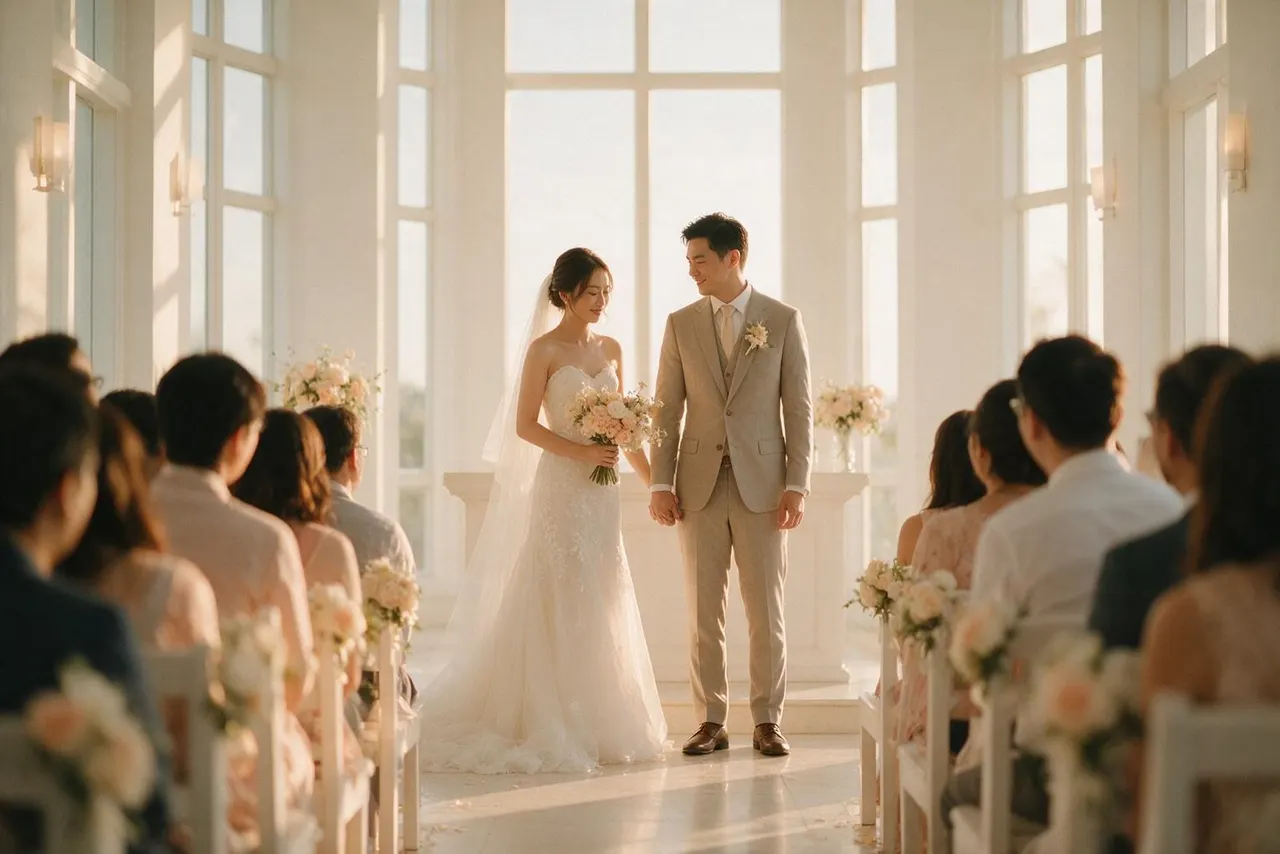
In short
A church wedding in Singapore brings a religious ceremony together with the country’s civil marriage law, and the two do not always happen in the same moment. Requirements for marriage preparation, notice, documents and photography vary by church and by denomination, so confirm the details for your date with your own church rather than relying on a friend’s wedding.
- Catholic weddings start with the parish: the Archdiocese asks couples to notify their parish about a year before the date, attend a pre-nuptial interview and complete a marriage preparation course.
- Protestant, Anglican and other churches publish their own membership, preparation and booking rules, which differ between congregations.
- A church wedding can include the legal solemnisation when a licensed solemniser conducts it, the marriage licence has been issued and all civil requirements are met. If you have not already completed the civil solemnisation and your religious officiant is not a licensed solemniser, arrange a licensed solemniser to conduct it at the same event or separately. No civil solemnisation can proceed before the marriage licence is issued.
- Photography and videography rules, including where a crew may stand, are set by each church.
- Since 25 September 2023, ROM has not required a hardcopy marriage certificate to be signed; the digital marriage certificate is the official proof of the civil marriage.
- Realistic timing between the church service and a banquet afterwards keeps the rest of the day on schedule.
Catholic weddings: what the Archdiocese requires
For Catholic weddings, the Chancery of the Roman Catholic Archdiocese of Singapore sets out the starting steps: notify your Singapore parish a year before the desired date, make an appointment for a pre-nuptial interview with a priest, and gather the documents, which include baptismal extracts for Catholic parties, birth certificates and a Marriage Preparation Course or Engaged Encounter certificate. If one of you is not Catholic, tell the priest at the first meeting; the chancery says he will take the necessary steps to obtain permission or dispensation from the Archbishop.
The Church of St Mary of the Angels describes the Marriage Preparation Course as an Archdiocesan apostolate comprising six half-day weekend sessions. The chancery lists either a Marriage Preparation Course or an Engaged Encounter certificate among the required documents, so confirm the appropriate preparation route and timing with your priest. Parishes then add their own conditions. The Cathedral of the Good Shepherd, for example, asks that at least one of you be a baptised Catholic, that a Catholic priest with a solemniser licence in Singapore has agreed to preside and solemnise, that the date be at least a year away, and that the preparation course and prenuptial inquiry are complete; a booking is confirmed only on payment and the presiding priest’s submission of the prenuptial enquiry form. St Joseph’s Church (Victoria Street) asks couples to meet their presider for the prenuptial inquiry at least six months before the wedding, with documents including a baptismal extract issued within the previous six months and the couple’s and witnesses’ NRICs or passports. Ask your parish, too, when it needs your marriage application to ROM submitted. If you need a solemniser for a separate civil step, our guide to finding a solemniser in Singapore covers that process.
Protestant and other church weddings
Protestant, Anglican and other churches publish their own membership and preparation rules, and these can differ between congregations. St Andrew’s Cathedral, for instance, accepts applications from couples who are both baptised Christians, single or widowed, aged 21 and above, and who have not registered their marriage with the Registry of Marriages; at least one party must be a confirmed member of the Cathedral, confirmed for at least a year, who worships regularly and takes an active part in church life there, and both must have an interview with a Cathedral pastor and complete the Cathedral’s marriage preparation course before applying.
Wesley Methodist Church asks that the bride or the groom be a member of the church and that both be Christian, requires the Marriage Preparation Course before the solemnisation or blessing of marriage, and permits only Methodist pastors to conduct weddings held there. Orchard Road Presbyterian Church requires a written application to its Session. Its published minimum criteria include both parties being active baptised or confirmed Christians, at least one being an active ORPC communicant member for at least one year, and neither having been divorced. Couples must complete the church’s Marriage Preparation Class at least six months before the planned date and pre-marriage counselling with the officiating minister; those unable to meet the course timing for special reasons should speak to the officiating pastor. Approval rests with the Session. The Armenian Apostolic Church of St Gregory the Illuminator welcomes all Christian denominations but states that it has no resident priest or pastor to conduct the ceremony, so couples arrange their own officiant, and it confirms dates only once a donation and deposit are received in full. Because of this variation, ask your own church directly what it needs from you, and how far ahead. If you are also arranging audio coverage of the vows, see our guide on capturing vows and speech audio.
Church and law: the solemnisation and ROM
A church wedding and Singapore’s civil marriage process are connected but not automatically the same event. As ROM puts it, “Since the inception of the Women’s Charter, Religious Leaders have partnered with ROM to combine religious ceremonies with civil marriages.” The officiating priest or pastor may also be a licensed solemniser, as the Cathedral of the Good Shepherd requires of its presiding priest. A church wedding can include the legal solemnisation when a licensed solemniser conducts it, the marriage licence has been issued and all civil requirements are met; the solemniser then registers the marriage with ROM. If you have not already completed the civil solemnisation and your religious officiant is not a licensed solemniser, arrange a licensed solemniser to conduct it at the same event or separately.
The paperwork sits alongside the ceremony: you submit your marriage application to ROM between six months and 21 days before the solemnisation, and the solemnisation can go ahead only once the marriage licence is issued. Since 25 September 2023, ROM has not required a hardcopy civil marriage certificate to be signed; the digital marriage certificate is the official proof, and signing ROM’s ceremonial certificate at an offsite solemnisation is optional. Ask your church separately whether its own marriage records need signatures. Because the sequence, and which licensed solemniser is involved, differs by church, confirm it with your church and with ROM well ahead of the date. Our guide on how ROM solemnisation works sets out the civil process in full.
Photography and video rules in church
Photography and videography rules inside a church are set by that church, and they can be specific. St Joseph’s Church (Victoria Street) states in its wedding guidelines that “your photographers and videographers are NOT allowed on the sanctuary during the Mass/Service”, and asks couples to arrange their own photographers and videographers, since the church does not provide them. St Andrew’s Cathedral requires a permit for any filming and for wedding, event or group photography on its grounds; its filming and photography page states that “for weddings held at St Andrew’s Cathedral, all wedding photography inside the Nave is not allowed except for the wedding couple getting married on the day itself”, and its conditions for shoots on the grounds rule out sound amplification and props such as confetti.
These are two examples, not a general rule, and other churches set their own positions on flash, movement near the altar and video lighting during the vows. Confirm the specifics with your own church, ideally when you first book the date, and pass them to your photography and videography crew well ahead of the wedding so camera positions can be planned around them rather than worked out during the service. Our guide on actual-day photography flow around a church ceremony covers how a crew usually moves through arrival, vows and recessional.
Choosing and booking the church
Booking windows vary, and some are fixed. Wesley Methodist Church begins accepting wedding applications on 1 March for the next calendar year and closes them four months before the wedding date; the Cathedral of the Good Shepherd asks couples to book a year in advance; and St Joseph’s Church (Victoria Street) asks couples to contact its administrator at least a year before the wedding to reserve a date. Days differ too. The Cathedral of the Good Shepherd, St Joseph’s Church (Victoria Street) and Wesley Methodist Church hold weddings on Saturdays only. The Cathedral of the Good Shepherd excludes Saturdays in Lent, days of obligation and public holidays; Orchard Road Presbyterian Church holds no weddings on Mondays, Sundays, public holidays or in December. A chancery booking form dated 16 February 2023 lists dates when wedding Masses and services cannot take place, including Christmas, Good Friday, Easter Sunday and Pentecost, so confirm the current exclusions with your church.
Some of these churches have long wedding histories: the National Heritage Board’s Roots story on weddings at religious national monuments notes that their prayer halls and sanctuaries “have over the years witnessed countless wedding solemnisations”, and includes a photograph of a 1950s wedding service at St Andrew’s Cathedral. Layout, light and seating differ from church to church, which affects both the ceremony and how it is photographed. If you are still comparing churches, our guide on choosing a church for your wedding ceremony covers what to look at when you visit, and what to ask about photography positions before you commit to a date.
Holding a banquet after
If you plan a banquet or reception at a separate venue after the church service, allow time for photographs, travel and any outfit changes between the two. Realistic travel time matters, particularly if the venues are some distance apart or the drive falls during a busier period of the day.
It also helps to decide what happens in between: whether there is a window for photographs, a change of outfit, or simply travel, and to share this plan with your photography and videography team so they know where to be and when. If you want the banquet itself covered on video as well as the ceremony, our guide on wedding videography sets out what that coverage typically includes.
Timing between church and banquet
The gap between the end of a church service and the start of a banquet is often used for family photographs, a couple’s portrait session, or simply travel and rest. How this time is used affects how much can realistically be photographed: a tight gap leaves room for little beyond the essentials, while a longer gap allows a more relaxed portrait session, possibly at a separate location.
Confirming this window early, and sharing it clearly with your photography and videography team, helps them plan how many formal group shots and portraits can fit in without delaying the rest of the day. Our guide on building a wedding day timeline walks through how to plan this alongside the rest of the schedule.
Family formals at the church steps
The church steps or entrance are a common spot for family formal photographs immediately after the service, largely because most guests are already gathered there and it is a natural point to assemble everyone before people start to disperse.
Having a list of the specific group combinations a family wants, immediate family, extended family, close friends, prepared in advance saves time and avoids forgetting a group once people start to leave. Weather, direct sunlight and the number of guests present all affect how long this part of the day takes, so it is worth allowing a reasonable buffer in the schedule rather than assuming it will be quick.
Rain plans
Singapore’s weather means an outdoor moment at the church steps, or a portrait session planned outside, can be disrupted by rain with little warning. Discuss an indoor backup location with your photographer in advance, a covered walkway, a hall within the church compound, or another sheltered spot nearby, so a sudden shower does not derail the plan for family formals or portraits.
Having this backup agreed on beforehand, rather than improvising in the moment, means the day can continue with minimal disruption if the weather does not cooperate. Checking your specific church’s own sheltered spaces when you visit, rather than assuming one will be available, is worth adding to the list of questions from your church visit.
Every church sets its own rules and its own rhythm, so confirm the details that matter for your date directly with your church and with ROM. If you would like to talk through coverage for your service and banquet, check your date with us, or read more about our actual-day wedding photography and wedding videography.