
In short
Roots’ Chinese Weddings entry describes the bride’s red qun kua as symbolising good fortune and happiness, and notes that some couples retain traditional Chinese outfits for rituals such as the tea ceremony. Roots collection records document metallic embroidery on historical bridal outfits. BiblioAsia describes mourning clothes being dyed black, while museum records of black-and-red bridal outfits complicate any simple rule against black. How much weight to give these colours is a decision for each couple and their families, rather than a fixed expectation.
- Roots’ Chinese Weddings entry describes the bride’s red qun kua as symbolising good fortune and happiness.
- Roots collection records show metallic embroidery on historical bridal outfits, such as phoenix and peony motifs in gold, silver and coloured thread.
- None of the sources reviewed states a rule against black or plain white at a wedding, so ask your family whether they have any preferences.
- Roots collection records of historical bridal outfits show a black blouse or jacket worn with a red skirt, including one acquired in Singapore from a 1937 wedding and one from Hong Kong described as a popular combination in the 1940s and 1950s.
- Roots’ Chinese Weddings entry also records a red tray for the matrimonial bed, a red umbrella and a red foldable fan.
- Dialect groups and individual families differ on several wedding customs, so ask your own parents or grandparents what matters to them rather than assume.
Which colours Roots records as auspicious
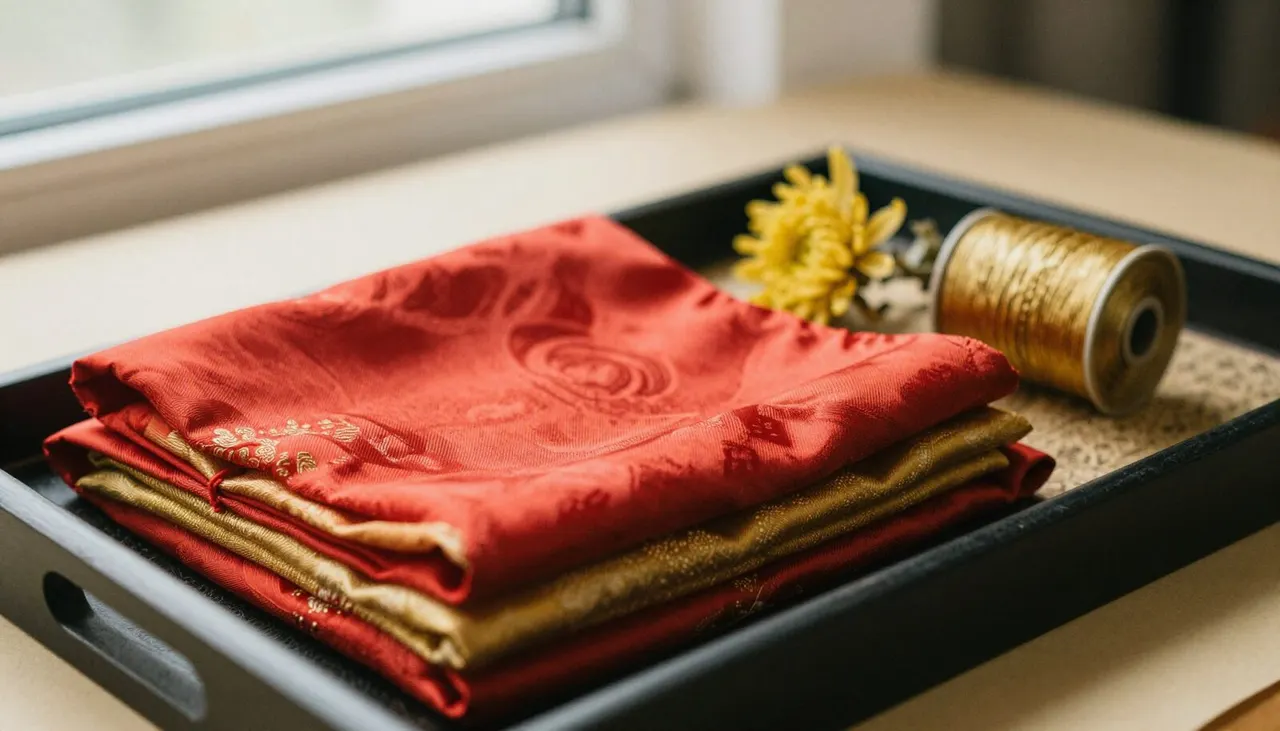
The National Heritage Board’s Roots portal describes the qun kua, the bride’s traditional wedding dress, as red and embroidered with auspicious symbols, and records that the red symbolises good fortune and happiness. Our guide to Chinese weddings in Singapore also summarises Roots’ account of the bride’s red qun kua and its symbolism.
A Roots collection record describes a bridal outfit worn in 1937, comprising a black blouse with phoenix and peony motifs in gold, silver and coloured metallic thread, and a red skirt; a separate record of a kua commissioned in Hong Kong in 1953 links its dragon and phoenix design to success, prosperity and a happy marriage. In these records, gold appears as part of the embroidery thread rather than as a separately documented colour with its own distinct meaning.
Black, white and a more complicated history
BiblioAsia, the National Library Board’s heritage publication, describes Sago Lane, once associated with death houses in Singapore, and the sou yi, or mourning clothing, worn by bereaved family members for a three-year mourning period, which the article describes as dyed black. The sources reviewed for this guide do not document plain white in Chinese funeral custom in the same detail, and none of them states a rule against wearing black or plain white at a wedding; our guide to Chinese wedding taboos suggests asking your family whether they have any preferences.
Roots’ own collection records complicate a simple rule against black, at least for the qun kua specifically. One record describes a kua worn by a bride who married in March 1937, with a black blouse embroidered with phoenix and peony motifs in gold, silver and coloured metallic thread; the same motifs appear on its red skirt. Another record, of a kua from Hong Kong with a Hong Kong shop tag, describes its black jacket and red skirt as a colour combination popular in the 1940s and 1950s. These records document black-and-red bridal outfits in specific historical contexts; they do not establish a colour rule for every family today.
How these colours show up in outfits
Roots notes that some couples retain traditional Chinese wedding outfits for rituals such as the tea ceremony, and describes the bride changing into a kua before the ceremony at her own family’s home. Roots records, through wedding planner Rubina Tiyu’s account, that Cantonese brides usually wear the qun kua when the groom comes to fetch them; her other dialect-group example concerns Teochew gatecrash timing, rather than colour choice.
If you plan outfit changes for the banquet, our guide to why brides change outfits during the banquet covers scheduling considerations. If a red or gold outfit matters to your family, discuss the preference with your family and whoever is styling you before finalising your outfits.
How these colours show up in decor and gifts
Red carries its auspicious meaning well beyond outfits. Our guide to red packet etiquette covers the documented exchange of red packets or jewellery at the tea ceremony and practical arrangements to discuss for receiving gifts at the banquet. Roots’ Chinese Weddings entry describes symbolic guo da li gifts, including mandarin oranges for good luck; our guide to what to wear for guo da li discusses outfit choices and family colour preferences.
Beyond weddings, Roots’ Chinese New Year entry describes red paper cuttings bearing auspicious words associated with prosperity, the younger generation offering greetings and oranges, and the older generation responding with red packets; it states that married persons give red packets regardless of age. Red’s association with good fortune runs across several occasions in the Chinese calendar, even where the specific custom differs.
Balancing tradition with your own style
Whether to follow these colour traditions closely, loosely, or not at all is a decision for each couple to make with their families, rather than a fixed expectation. Where a couple wants to blend a personal palette with tradition, one approach worth discussing is keeping a traditional colour, such as red, for a specific moment like the tea ceremony, while choosing a different palette for the banquet decor or an evening outfit.
Where colour matters more to parents or grandparents than to the couple themselves, it is worth having that conversation early, since it can affect decisions on outfits, decor and stationery well before the wedding day itself. Roots records, through Ms Tiyu’s account, that she encourages couples to ask their own families rather than assume, since her view is that a family’s wishes should not be disregarded on an occasion like this.
What varies by family, and questions worth asking
The sources reviewed for this guide do not describe a single colour rule that applies to every Chinese family in Singapore, so ask your family which preferences they wish to observe. Beyond colour, ask your family whom they would like to perform any rituals you plan to include.
If colour matters to your family, ask which moments of the day they consider most important for observing tradition, rather than assuming every outfit, decoration or gift needs to follow the same rule. A short conversation early in your planning leaves more room to adjust than discovering a strong preference once outfits or decor are already booked.
Photographing these colours well
Red and gold can look different depending on the lighting and backdrop. Discuss your colour choices with your photographer in advance so they can plan positioning across your venues and assess exposure under the lighting on the day.
If a pre-wedding shoot is part of your plans and you want it to feature traditional colours, raise this early as well, so that locations and lighting can be chosen with those colours in mind from the start.
Use the sources above as a starting point, and ask your family which customs they wish to observe. If auspicious colours matter to your family, check your date with us to talk through your outfits and decor, or read more about our actual-day wedding photography.