
In short
A Chinese wedding in Singapore can include rituals before the wedding day as well as celebrations on the day itself. Most of the customary rituals take place at the homes of the bride and groom, in the weeks before the wedding and on the morning itself, while the banquet is commonly held that evening at a restaurant, hotel ballroom or event hall. Wedding planners and Chinese wedding speciality shops now guide many families through these customs, a role once held by professional matchmakers known as mei po (媒婆).
- Guo da li (过大礼), the betrothal gift exchange, is usually held two to four weeks before the wedding, when the groom brings gifts to the bride’s family.
- An chuang (安床), setting the matrimonial bed, takes place three days to a week before the wedding, and shang tou (上头), the hair-combing ritual, the night before, at the bride’s and groom’s respective homes.
- On the wedding day itself, the groom completes a gatecrash at the bride’s home before the couple hold a tea ceremony, first at his home and then at hers.
- The evening banquet often includes a march-in, a group toast the National Heritage Board spells yam seng (commonly written yum seng), and the couple visiting each table.
- Customary wedding rituals do not replace the legal marriage process, through ROM for civil marriages or ROMM where both partners are Muslim.
- Many of the details vary by family and, in places, by dialect group, so it is worth asking your own parents what they expect rather than assuming.
The shape of a Chinese wedding in Singapore
The National Heritage Board’s Roots portal describes Chinese weddings in Singapore as taking place mainly across two settings: the homes of the bride and groom, where most of the rituals happen, and a separate venue for the banquet. Roots describes guo da li as taking place two to four weeks before the wedding, other rituals on the wedding morning, and the banquet that evening.
Roots describes the banquet as bringing together family, friends and colleagues, commonly at a restaurant, hotel ballroom or event hall. Roots notes that the families of the bride and groom are directly involved throughout the wedding, while other relatives and friends help with planning and take part in specific rituals and activities.
Roots also notes that wedding planners and Chinese wedding speciality shops have, in practice, taken over much of the role once played by professional matchmakers known as mei po (媒婆), who traditionally provided families with knowledge of wedding rituals and customs. Roots also quotes wedding planner Rubina Tiyu, who finds that couples do turn to planners for information on Chinese wedding practices, but that the family remains the most important institution involved.
Choosing the date
Timing matters throughout a Chinese wedding. Roots notes that guo da li is held on “an auspicious day” two to four weeks before the wedding, and that during the hair-combing ritual the night before, an auspicious phrase is repeated with each stroke of the comb. Our guide to auspicious dates and peak wedding season in Singapore notes that some Chinese families in Singapore consult the Tong Shu, a traditional Chinese almanac, or a geomancer when choosing the wedding date, while others choose on practical grounds such as venue availability.
Discuss any auspicious-date preferences with your families alongside practical considerations such as venue availability. If a particular date matters to your parents, raise it early, since it can affect when jewellery, outfits and other preparations need to be ready.
Guo da li: the betrothal gifts
Most Chinese wedding practices in Singapore begin, according to Roots, with a betrothal ceremony called guo da li (过大礼). It is held two to four weeks before the wedding, on an auspicious day, and involves the groom, accompanied by a female relative, bringing gifts to the bride’s family. This is also when the bride receives her trousseau, known as jia zhuang (嫁妝).
The bride’s family then returns a portion of the gifts, known as hui li (回礼), to symbolise their acceptance of the marriage, and presents the groom’s family with a further set of gifts in turn. Roots describes the items exchanged as usually elaborate, chosen for their symbolism: mandarin oranges are given for good luck, for example, while charcoal signifies a good life after marriage.
Exactly which items appear on the day, and in what quantities, is a family decision. Our dedicated guide to guo da li in Singapore goes through this in more detail, since it is a custom where family and dialect-group differences often show up.
An chuang: setting the bridal bed
An chuang (安床), the preparation of the matrimonial bed, takes place three days to one week before the wedding, according to Roots. The bed is made up with new linen, and a big red tray is placed on it, filled with an assortment of items meant to signify prosperity for the couple.
Roots also describes a further step that happens on the wedding day itself, before the bridal couple arrive: a young boy, ideally one born in the Year of the Dragon, is asked to jump and roll on the matrimonial bed, as a way of blessing the couple with many children. Our guide to the an chuang ceremony goes through who is usually asked to prepare the bed and how families plan around it.
Shang tou: the hair-combing ritual the night before
Shang tou (上头), the hair-combing ritual, takes place the night before the wedding, at the respective homes of the groom and the bride. Roots describes each of them facing a pair of lighted candles while a woman considered to have good fortune, someone whose husband, children and grandchildren are all still living, combs their hair four times, reciting an auspicious phrase with each stroke. The ritual is understood to mark the couple’s transition into adulthood.
As with other pre-wedding customs, families differ on who is asked to perform this role and how closely the details are followed. Our guide to Chinese wedding day taboos notes that rituals such as bed-setting and hair-combing often specify who should perform them, so ask your families who they would like to take part.
The wedding morning: gatecrash, the red umbrella and the fan
On the wedding day itself, the groom travels to the bride’s home to bring her back to his. Before he can see her, Roots describes a ritual known as “gatecrashing”, where the bridesmaids set the groom and his groomsmen a series of playful tasks to complete. Our guide to gatecrash photography covers capturing the room’s reactions, not only the games; brief your photographer on the tasks and where they will take place.
As the bride leaves her family home, she is sheltered with a red umbrella. Roots notes that when she gets into the bridal car, she throws a red foldable fan, known as the Lady Fan, out of the car window, to symbolise leaving negative things behind. Some families time this departure closely: Roots records, through a wedding planner’s account, that the Teochews believe the bride should leave her home before sunrise, and so hold the gatecrash ritual very early in the morning.
The tea ceremony at both homes
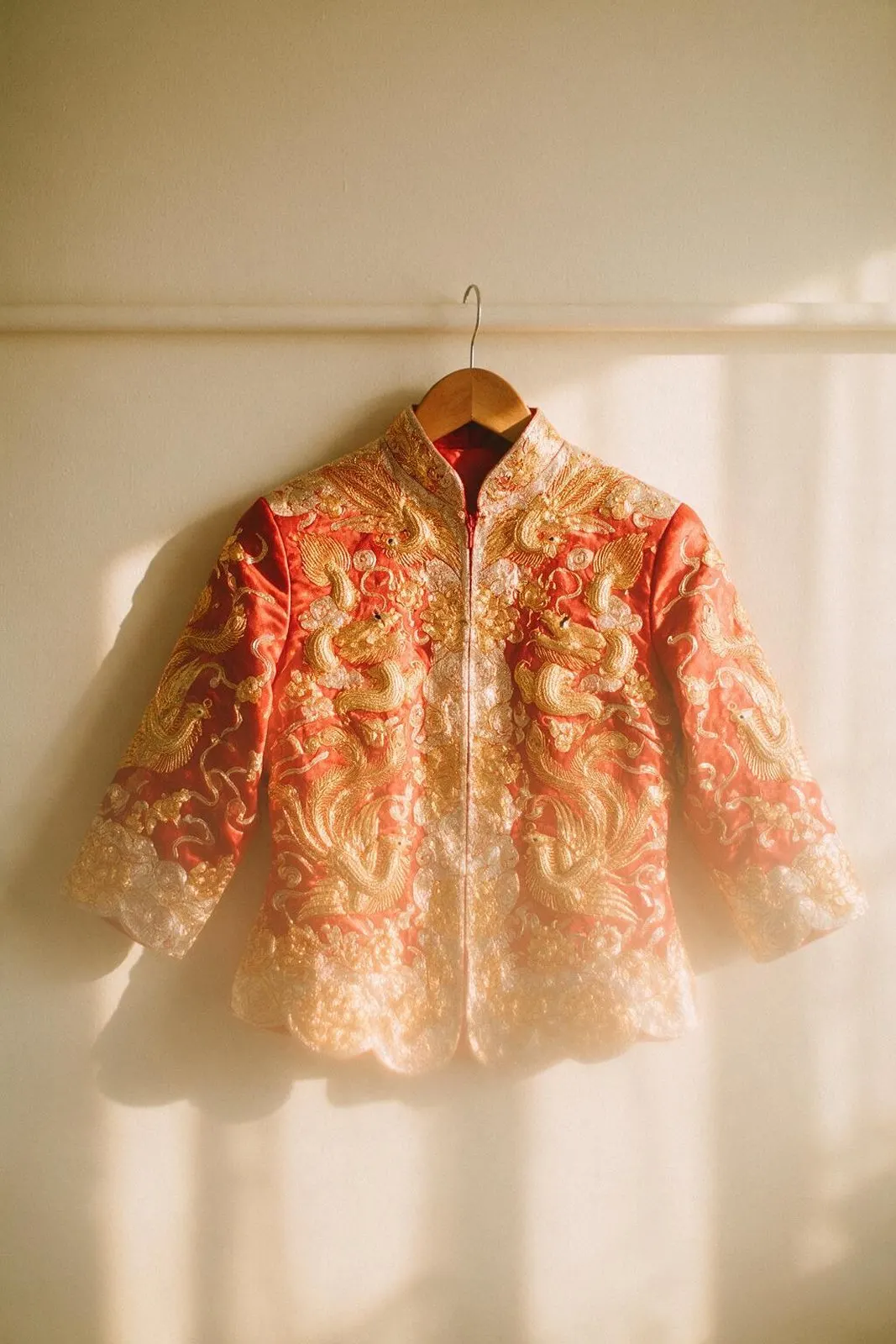
The tea ceremony usually happens twice on the wedding day: first at the groom’s home, then at the bride’s. Where a family worships deities and ancestors at home, Roots notes that the couple prays at the family altar first, before serving tea to the elders, who give their blessings in return. The couple then travel to the bride’s home, where she changes into a kua (褂), a traditional red wedding dress embroidered with auspicious symbols, to hold a separate ceremony for her own family.
The Roots portal’s entry on tea customs also notes that the couple offer tea to each other afterwards, in a ritual said to symbolise mutual trust and goodwill, and that tea is typically served throughout the banquet as well if it is held at a Chinese restaurant. By custom, as our own tea ceremony guide describes, everyone served during the ceremony gives the couple a red packet or a piece of jewellery in return; see our guide to red packet etiquette for how families usually handle the giving and receiving.
Attire: qun kua, kua and ma kua, and outfit changes
Roots notes that many couples today prefer western suits and gowns for their weddings, while some retain traditional Chinese outfits for rituals such as the tea ceremony: the ma kua (马褂) for the groom, and a red qun kua (裙褂) for the bride, its embroidery often featuring phoenix and floral motifs. The red is said to symbolise good fortune and happiness. Earlier in the day, as noted above, the bride changes into a kua (褂) before the second tea ceremony at her own family’s home; Roots records, through the same wedding planner’s account, that among the Cantonese the bride usually wears the qun kua as her wedding dress when the groom comes to fetch her.
Beyond these rituals, some couples change outfits again for the banquet itself, and sometimes once more later in the evening. Our guides to why brides change outfits during the banquet and auspicious colours in Chinese wedding traditions cover scheduling outfit changes and how auspicious colours can fit into at least one of the looks.
The banquet: march-in, yum seng and table visits
The banquet is the last part of the wedding day, bringing together family, friends and colleagues, commonly at a restaurant, hotel ballroom or event hall. Early in the evening, the couple make their formal entrance in a march-in; our guide to the wedding march-in goes through what this moment represents beyond the entrance itself.
During the dinner, the couple’s entourage is invited on stage for a toast that Roots spells yam seng, involving the whole hall shouting the phrase, or “cheers”, three times as loud as they can, to congratulate the couple and confer blessings. You may also see this written yum seng, as in our own guide to the yum seng toast. Roots describes the couple then visiting each table to toast the guests; our guide to banquet course etiquette explains how table visits and other segments fit into the pauses between courses. For guests, our guide to wedding ang bao rates covers how people decide what to give, rather than a fixed figure here.
The legal side: ROM
None of the customs above are what make a marriage legal in Singapore. A couple is legally married once their marriage is solemnised and registered with the Registry of Marriages (ROM), which administers civil marriages under the Women’s Charter; where both partners are Muslim, the marriage goes through the Registry of Muslim Marriages instead. For civil marriages, couples submit their marriage application online between six months and 21 days before the solemnisation, which a licensed solemniser conducts in the presence of two witnesses above 21, at a ROM site or another venue of their choosing; see the official civil marriage process page.
Some couples hold their solemnisation on the same day as the wedding banquet, sometimes at the banquet venue itself; others solemnise weeks or months apart from the customary celebration. For a civil marriage, the licensed solemniser conducts the solemnisation and then registers the marriage with ROM; the tea ceremony and the banquet are celebrations, not part of the legal process. Our guide to how ROM works in Singapore goes through the application, the notice period, witnesses and what happens on the day itself.
Dialect groups and family differences
Roots records, through the experience of wedding planner Rubina Tiyu, that Chinese dialect groups in Singapore have their own practices and traditions. Beyond the Cantonese and Teochew examples mentioned above, Ms Tiyu’s advice to couples is to ask their families: “you don’t want to disrespect them at the end of the day.” Practices can differ even between families of the same dialect background, so ask rather than assume a custom applies uniformly.
Chinese Peranakan families have their own documented wedding customs, such as chiu thau and lap chai, which our guide to Peranakan weddings describes, noting that museum records find Peranakan wedding practices closely resembled old wedding customs in Fujian province.
Roots also notes that many couples still maintain several of the core wedding practices described here, though modernisation, busy schedules and budget constraints have led some families to simplify certain rituals, and some couples are simply unaware of the meaning behind a given custom and so do not follow it. None of this makes one approach more correct than another; the rituals that matter are the ones your own families choose to keep.
Planning the photography across the day
A Chinese wedding can be spread out, with meaningful moments at two homes, some of them weeks before the banquet. Ask your families how long each ritual is expected to take, including preparation and each round of tea, and share those timings with your photographer; a photographer who does not know the run of the day in advance can miss a moment simply by not being in the right room at the right time.
Sharing a run sheet with your photography and videography team well before the day, covering which rituals you are keeping, roughly what time each one starts, and which home each takes place at, makes a considerable difference to what is captured. Our guide to the wedding day timeline sets out how a Singapore Chinese wedding day with a gatecrash and tea ceremony can run, from two homes in the morning to the banquet’s march-in, yum seng and table shots.
Because so much of a Chinese wedding happens away from a single venue, it is also worth confirming travel time between homes, and between the ceremony location and the banquet, so your coverage team can move with you rather than racing to catch up.
Every family runs their wedding a little differently, and the customs above are common starting points rather than fixed rules. If you would like to talk through which rituals your family is keeping, check your date with us, or read more about our actual-day wedding photography.