
In short
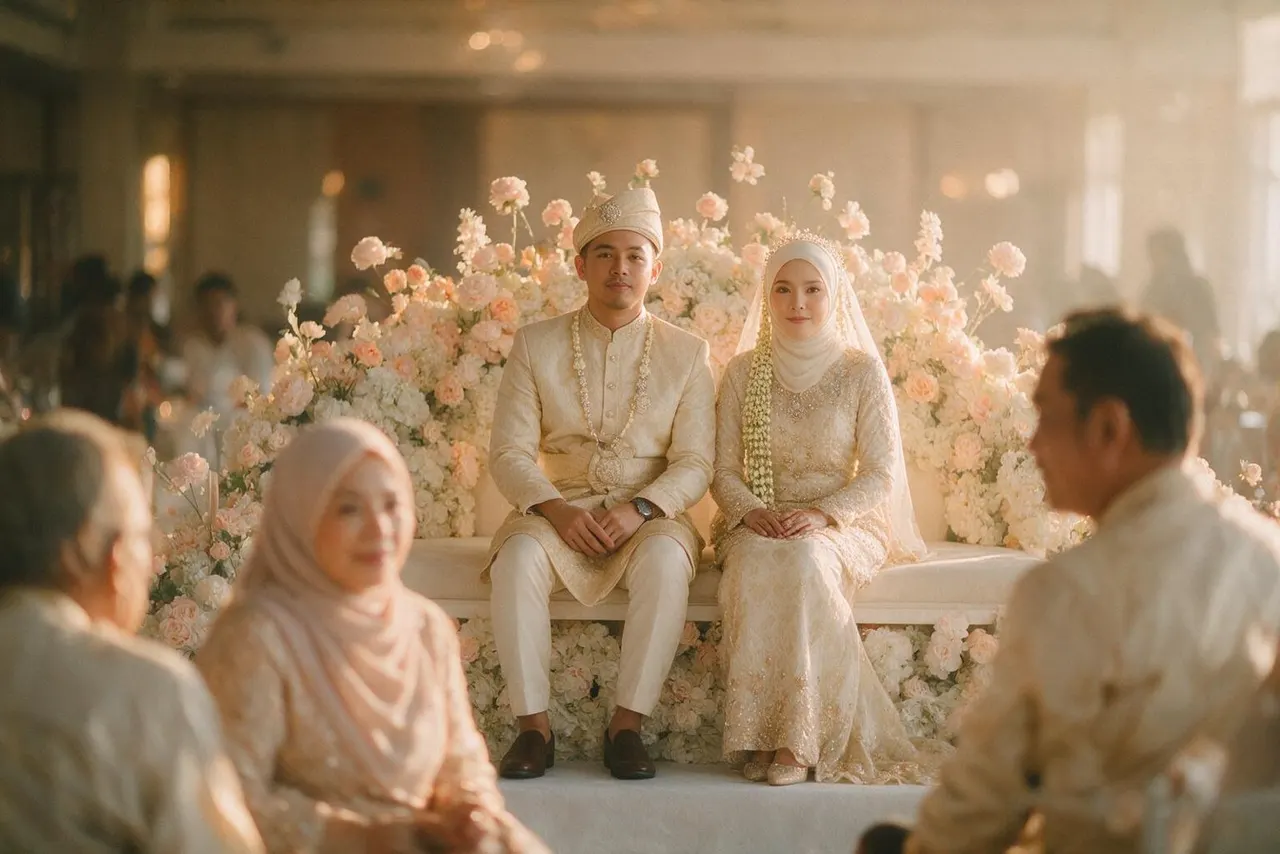
A Malay wedding in Singapore centres on two distinct parts: the akad nikah, the Muslim solemnisation registered with the Registry of Muslim Marriages (ROMM), and the bersanding, the celebration at which the couple is seated in state on the pelamin for guests. Some families hold both on the same day; others hold the solemnisation separately, before the celebration, alongside a number of customs before and around the wedding itself.
- The akad nikah is the legal and religious solemnisation, conducted by a Kadi or Naib Kadi, normally with the bride’s wali and two witnesses, and registered through ROMM.
- The bersanding and the wider majlis are the celebration that follows, often but not always on the same day as the akad nikah.
- Customs such as berinai (henna), hantaran (gifts) and a kompang procession may appear before or around the day, depending on the family.
- Venues range from a home or void deck to a mosque, community hall or hotel, each with different photography considerations.
- Malay wedding attire, songket fabric and prayer times all shape how the day is planned and photographed.
The shape of a Malay wedding in Singapore
In Malay custom, the newlyweds are traditionally treated as raja sehari, king and queen for a day. The core events are the akad nikah, the solemnisation itself, and the walimah, the wedding feast, at which the bersanding, the couple’s sitting in state, is usually the centrepiece. A bertandang, a ceremony to welcome the bride or the in-laws, sometimes follows as well.
Older accounts describe the akad nikah as taking place the day before the walimah and bersanding, with celebrations historically spread across a week. Many families today instead hold the akad nikah, the walimah and the bersanding on the same day, though some still hold the solemnisation separately, before the celebration. Neither pattern is more correct than the other, so agree the structure with both families early, since it shapes the rest of your planning.
Before the wedding: merisik, meminang and the engagement
Roots, the National Heritage Board’s heritage portal, describes a typical Malay wedding as a series of five steps that begin well before the wedding day. In merisik, or investigating, the parents of a man wishing to marry employ a tukang risik, a matchmaker, to enquire into and assess the qualities of a future bride; in meminang, the proposal, the two families meet to get to know one another. Roots notes that both practices have declined over time but are still observed as a formality that allows the man’s family to put forward a marriage proposal.
In the traditional sequence described by Roots, the families agree during meminang on duit hantaran, a sum for wedding expenses, the engagement date and the number of dulang, or gift trays, to exchange at the engagement. Roots describes pertunangan, the engagement, as a major ceremony in which families wear formal Malay clothes and the groom’s family brings decorated trays typically containing an engagement ring, cakes, sweets, potpourri and sireh junjung, a bouquet intended to stand taller than the bride’s sireh dara. Roots adds that senior male representatives may carry on a dialogue in poetry using kata hiasan, ornamental language. If your families hold an engagement, tell your photographer, since the dulang, the bouquets and the exchange between the families are worth documenting in their own right.
The akad nikah: solemnising through ROMM
When both partners are Muslim and aged 21 and above, the marriage is registered through the Registry of Muslim Marriages (ROMM), separate from the civil Registry of Marriages; if one partner is not Muslim, the civil process at the Registry of Marriages applies instead. Both processes are applied for online through the Our Marriage Journey portal at marriage.gov.sg. Since November 2025, supporting documents are submitted together with the application, and the solemnisation can only go ahead once the application has been reviewed and approved.
Consent from the bride’s wali, her lawful guardian, is normally one of the first steps: the wali is responsible for satisfying himself that the groom is a reliable person before the marriage goes ahead. At the solemnisation, a Kadi or Naib Kadi, an appointed religious official, checks the identification of the bride, groom, wali (where one takes part) and the two witnesses, and asks both parties for their verbal consent. A Kadi is empowered to consider marriage applications and solemnise marriages with or without a wali and the wali’s consent; a Naib Kadi can only solemnise a marriage with a wali. The two witnesses must each be a male Muslim above 21.
The Kadi or Naib Kadi then gives a short sermon on marriage (khutbah), and either the wali conducts the akad nikah himself or authorises the Kadi or Naib Kadi to do so on his behalf. The groom reads a set of special marriage conditions (taklik), prayers are recited (doa), and the groom hands the bride the maskahwin, the marriage gift covered below. The whole solemnisation takes about 30 minutes, and a digital marriage certificate is emailed once it is registered.
The steps from consent to certificate
Getting to the akad nikah involves more than booking a date. ROMM sets out a sequence of steps for couples to work through:
- The wali’s consent. The bride’s wali normally agrees to the marriage before the application moves ahead; where that is not possible, a Kadi, rather than a Naib Kadi, handles the application.
- Preparing for marriage. Couples are pointed towards the Our Marriage Journey quiz and marriage preparation programmes.
- Preparing the application. This covers the date, time, venue, maskahwin and hantaran, inviting a Kadi or Naib Kadi, and confirming the wali’s availability and two witnesses.
- Submitting the application and paying the fee. This is when the notice period and the application’s validity begin.
- Bersamamu. A face-to-face session with the Kadi or Naib Kadi, who continues to offer support for up to two years after the solemnisation.
- The declaration. Made under the Administration of Muslim Law Act, by video link, in person, or online if the couple and wali meet the requirements.
- The solemnisation. The akad nikah itself, after which the marriage is legally registered and a digital certificate is emailed.
Because a Kadi or Naib Kadi for an offsite solemnisation is booked from an available list rather than assigned automatically, it helps to start this process with some room to spare, particularly around a popular date.
Fees, notice and choosing where to hold it
The maskahwin, also called mahar, is a gift from the groom to the bride, handed over after the solemnisation as cash or as a token such as a ring or bracelet; the current minimum rate is SGD 100 cash. Hantaran is a separate, optional item on the application, described by ROMM as a customary gift from the groom to the bride’s family, with the amount mutually discussed and agreed between both sides rather than fixed.
Couples must submit their application at least 21 days before the solemnisation date, and the application expires 150 days after submission, so it is worth timing the application so the solemnisation falls comfortably inside that window, particularly for a popular date that may make a Kadi or Naib Kadi harder to book. The application fee is SGD 39 if either party is a Singapore citizen or permanent resident, and SGD 128 if both are foreigners; changing the solemnisation details afterwards, such as the date, time or venue, costs SGD 15 and must be done no later than 8 days before the date.
An akad nikah can be held at ROMM itself, Monday to Friday during office hours and excluding public holidays, with a Kadi or Naib Kadi provided and a house limit of 20 people including the couple and witnesses, where photography and videography are both permitted; arriving at least 15 minutes before the scheduled time and checking in at the reception counter is worth building into the day’s plan. Away from ROMM, families can choose any day, including weekends and public holidays, and any venue, such as a home, a mosque, or an outdoor location like Mount Faber or the Botanic Gardens, subject to the availability of the Kadi or Naib Kadi they invite. Kadis and Naib Kadis volunteer their time, so no fee is expected, though couples may reimburse their incurred costs as appreciation. Punctuality matters: if a couple is 15 minutes late, the Kadi or Naib Kadi may leave and return to conduct the solemnisation when next available.
Attire matters too: the Kadi or Naib Kadi may decline to proceed if it is judged inappropriate. The expected standard is a dress shirt and trousers or other traditional or formal wear for the groom, and a dress or other traditional or formal wear for the bride.
Before the day: mak andam and berinai
Bridal preparation traditionally involved a mak andam, a bridal specialist who guided the bride through more than her hair and make-up, coaching her posture and readiness for the pelamin as well. In its account of wedding customs, Roots describes a mak andam being chosen at least three months before the bersanding. In its profile of mak andam Shima Matin, Roots notes that the role may have shifted from the bride’s traditional guardian towards fashion and beauty advice. Some families still engage someone for this fuller traditional role, while others work with a modern make-up artist instead; our guide to the mak andam covers how families are approaching this today.
Henna is traditionally applied in up to three berinai ceremonies, the berinai curi, the berinai kechil and the berinai besar, held at different points around the wedding. All three are rarely held today, partly because of the cost and time involved. Our guide to henna night covers what typically happens and how to plan around it.
Hantaran and bunga telur: gifts and favours
Hantaran is described by the Registry of Muslim Marriages as an optional, customary gift from the groom to the bride’s family, mutually discussed and agreed upon by both parties; Roots describes the sum for wedding expenses, duit hantaran, being agreed at the proposal, and decorated trays of gifts, dulang, being exchanged at the engagement; BiblioAsia describes both parties customarily exchanging dulang hantaran at the nikah, with the groom presenting the pre-agreed duit hantaran and the mas kahwin. What is included, and its value, is for both families to agree rather than anything fixed. Our guide to hantaran covers how families typically arrange and present it.
Some families also prepare bunga telur for guests, a favour made from a dyed hard-boiled egg set on a bed of yellow glutinous rice, in a glass decorated with flowers. The egg is traditionally said to represent fertility and prosperity, the rice, harmony, and the flower, love in the marriage; many families today give simpler favours, such as small cakes or household items, instead. Roots also notes that guests may receive bunga rampai, a potpourri of finely cut pandan leaves and scented flowers, traditionally wrapped in cones of sireh leaf or handkerchiefs, or placed in small containers.
The kompang procession
A kompang procession, a group of players on handheld frame drums, traditionally announces the groom’s arrival at the wedding venue. Roots describes the groom arriving with his entourage and the kompang, flanked by bunga manggar, decorative palm blossoms, as he leads his relatives and friends to the bride’s home. Our guide to the kompang procession covers how groups are typically booked and how to photograph a moving procession.
Bersanding, the pelamin and merenjis
Bersanding, sitting together, is the point at which the couple is seated in state on the pelamin, the decorated dais, as the centrepiece of the celebration. Before the groom reaches the bride, tradition has him overcome a series of hadang, or playful obstacles, set by her side, and hand over duit kipas, fan money, before she is revealed to him. BiblioAsia describes a silat pengantin, a Malay martial arts display, being performed for the groom once he has passed the tests and is seated before the bridal dais. The role of pengapit, the groom’s attendants for this part of the day, was traditionally filled by older relatives; today it is more often filled by friends.
Merenjis is a blessing in which guests sprinkle rose water and yellow rice on the couple while they are seated at the pelamin; it is less common today than it once was, so ask whether your families plan to include it. Roots describes tepung tawar as a traditional ceremony in which family members may sprinkle rose water and rice grains on the couple, then smear rice flour paste onto the couple’s palms to signify blessings and well-wishes. Merenjis tends to involve guests taking turns, so ask your family how many people will participate and allow time accordingly.
The pelamin is often elaborately decorated, and families put considerable effort into its design, so it is worth treating it as an important backdrop to photograph in full, not only as a setting for portraits of the couple. Lighting varies considerably by venue, from fluorescent lighting at a void deck or community hall to more controlled staging at a hotel, so scouting the pelamin and its lighting before the couple is seated gives time to adjust rather than working it out once the ceremony has started.
Where the majlis is held
The majlis, the wider wedding celebration, and its bersanding can take place in a range of settings: a void deck decorated for the occasion, a community centre or CC hall, or a hotel ballroom, depending on the family’s plans and the scale of the celebration. Each setting brings its own practical considerations. A void deck event may be more exposed to weather, ambient noise and passers-by, while a hotel ballroom offers more controlled lighting and space but may come with its own house rules on photography setup. Our guide to the majlis covers what else typically happens at this event.
Confirming the exact venue and its layout in advance, rather than assuming a hotel-style setup, helps a photographer and videographer plan equipment and positioning that suits the actual space rather than a generic one. Where the akad nikah is held in the morning and the majlis in a hall later the same day, or on a different day entirely, our guide to covering a morning ceremony and an evening banquet covers how a crew typically plans the split.
Two families, sometimes two receptions
Some Malay weddings involve celebrations hosted separately by the bride’s side and the groom’s side, sometimes on different days or at different venues, each with its own bersanding and its own guests. Confirm with the couple early whether coverage is needed for one event or two, since this affects scheduling, travel between venues, and whether the same crew can cover both or whether a second team is needed.
Where two receptions do take place, some elements, the pelamin, the attire, the guest list, may differ noticeably between the bride’s event and the groom’s event, so it is worth treating each as its own shoot to plan for rather than assuming the second will mirror the first.
Attire: baju kurung and songket
Malay wedding attire commonly includes the baju kurung for the bride and the baju Melayu for the groom, often made from or paired with songket, a fabric woven with metallic gold or silver threads. Songket in particular reflects light differently from plain fabric, which can affect exposure and how detail in the fabric’s pattern shows up in photographs, especially under mixed indoor lighting.
Because these outfits and their accessories, headpieces, jewellery, layered fabric, are often a significant part of the family’s preparation, it is worth allowing time before the ceremony for close, detailed shots of the attire itself, not only wide shots of the couple wearing it.
Modesty and gender considerations
Some families prefer a female photographer or videographer to be present in the bride’s preparation room, particularly if the bride will remove her headscarf or be in a state of undress at any point before being fully dressed. This varies by family, so it is worth asking directly, well before the wedding day, rather than assuming either way.
More broadly, it helps to ask the couple or their family about any modesty expectations for the day, where cameras should not point, whether certain moments in the preparation room are considered private, and whether there are guests who prefer not to be photographed closely. Every family’s comfort level is a little different, and asking in advance avoids a difficult moment on the day itself.
Working around prayer times
Prayer times can shape the schedule of a Malay wedding day, particularly if the akad nikah, meals or breaks are planned around solat. It is worth asking the family or the appointed coordinator whether specific prayer times need to be built into the day’s run sheet, and whether the crew should expect a pause in proceedings around those times.
Building this into the schedule from the start, rather than treating it as an interruption if it comes up, keeps the day running smoothly for the family and avoids a photographer or videographer being caught mid-setup when the programme naturally pauses.
Every family runs their akad nikah and bersanding a little differently, so the details above are general starting points to confirm rather than fixed rules. If you would like to talk through coverage for your akad nikah, bersanding or celebration, check your date with us, or read more about our actual-day wedding photography.