
In short
An Indian wedding in Singapore is rarely a single event, and rarely a single tradition. Singapore’s Indian community spans several language groups and faiths, so a Tamil Hindu temple ceremony, a Sikh Anand Karaj, a Muslim akad nikah and a church wedding can all sit under the same broad description while looking quite different in practice. The rituals, the legal registration and the photography are best planned around the family’s own customs rather than a fixed script.
- Weddings often span pre-wedding events, a religious ceremony and a reception, though which events appear varies by family.
- Singapore’s Indian community includes Tamil, Malayalee, Punjabi, Sindhi, Gujarati and other groups, and Hindu, Sikh, Muslim and Christian families, each with its own customs.
- Where at least one partner is not Muslim, the marriage is registered with the Registry of Marriages (ROM), and a licensed solemniser who is also a religious leader can combine this with the religious ceremony. Where both partners are Muslim, it is registered through the Registry of Muslim Marriages (ROMM).
- Rituals such as the thali or mangalsutra, mehndi, haldi, muhurtham timing and the saptapadi vary by community and family, and each has its own guide linked below.
- Tamil Hindu weddings in Singapore usually take place in a temple, and temples such as Sri Mariamman Temple and Sri Srinivasa Perumal Temple have long hosted wedding ceremonies.
- Long ceremonies, temple or gurdwara etiquette and events spread across several days all shape how photography is planned.
The shape of an Indian wedding in Singapore
Families often plan a run of pre-wedding gatherings in the days beforehand, the wedding ceremony itself and a reception, but not every family holds every one of these, or in the same order.
Which pre-wedding events appear, and in what form, depends on the community and the family. Some hold a mehndi ceremony for the bride and her bridal party before the wedding day, where, in the words of the National Heritage Board’s Roots portal, the application of henna is believed to “symbolise protection, health and fertility of the bride”. Others add a sangeet evening of music and dance, a custom associated with North Indian weddings, or a haldi turmeric ritual, and some hold none of these. The ceremony itself is usually religious, officiated by a priest, a granthi, a Kadi or Naib Kadi, or a member of the clergy depending on the family’s faith, and is followed, on the same day or later, by a reception or a meal for guests.
It helps to list early which events you are holding and in what order, and to share that list with your photographer, since a pattern taken from one Indian wedding can leave out an event another family considers central.
Many communities, many customs
Singapore’s Indian community is not one group with a single set of customs. It includes Tamil, Malayalee, Telugu, Punjabi, Sindhi, Gujarati and other language and regional groups, and Hindu, Sikh, Muslim and Christian families. The Indian Heritage Centre describes Malayalees, whose ancestral home is Kerala, as the second largest sub-group within Singapore’s Indian population, and a National Library Board BiblioAsia article traces how regional communities went on to form “the Sindhi Association, the Gujarati Association, the Sikh Association and several other linguistic and regional organisations”.
Faith and language do not line up neatly either. The same BiblioAsia article describes the early Tamil business community as “both Hindu and Muslims”, so one Tamil family’s wedding may be a temple ceremony and another’s an akad nikah.
Because customs differ between communities, and sometimes between families within one community, the useful starting point is your own families’ practice rather than a general Indian wedding formula. The sections below note where a custom belongs to a particular community.
The legal side: ROM, ROMM and the religious ceremony
Which legal process applies depends on the couple’s faith. Where at least one partner is not Muslim, the marriage is a civil marriage registered with the Registry of Marriages (ROM). Where both partners are Muslim, it is registered through the Registry of Muslim Marriages (ROMM), with its own solemnisation, the akad nikah. Both are applied for through marriage.gov.sg, at least 21 days before the solemnisation; see the official civil marriage process and Muslim marriage process pages for the current steps.
For a civil marriage, only a licensed solemniser can conduct and register it. ROM notes that since the inception of the Women’s Charter, religious leaders have partnered with it to combine religious ceremonies with civil marriages, and that the partnership has since grown to include Justices of the Peace and grassroots leaders. So a temple, gurdwara or church ceremony and the legal solemnisation can be one event, provided the officiant is a licensed solemniser and the marriage licence has been issued in time. If the religious officiant is not a licensed solemniser, another licensed solemniser must conduct the civil solemnisation, either as part of the same event or at a separate appointment.
For an offsite civil solemnisation, you invite a solemniser through the marriage portal, usually three to six months ahead, and can hold it at a venue of your choice on any day, including weekends and public holidays. At a ROM site, ROM provides the solemniser and the slot is booked with the application.
Where both partners are Muslim, the akad nikah is officiated by a Kadi or Naib Kadi, appointed religious officials. Normally the bride’s wali, her lawful guardian, either conducts the akad nikah himself or authorises the Kadi or Naib Kadi to do so, and two male Muslim witnesses above 21 attend. Solemnisation at ROMM is available from Monday to Friday, excluding public holidays, during operating hours and subject to available slots; offsite, at home, at a mosque or at another venue, it can take place on any day, including weekends and public holidays, subject to the Kadi or Naib Kadi’s availability.
Because the two processes run through different registries, it is worth confirming early which one applies, and whether the legal solemnisation will be part of the religious ceremony or a separate appointment. That decides who officiates and when the ceremony can be scheduled. Our guide to ROM solemnisation covers the civil process step by step, and our guide to Malay weddings walks through the akad nikah at ROMM.
Rituals before and during the ceremony
A number of named rituals recur across Indian weddings in Singapore, though which ones a family observes, and in what form, depends on their community. Several have their own guide.
For Hindu weddings, Roots describes the gold pendant, “known as thali in South Indian, or mangalsutra in North India”, as one of the most significant symbols of marriage. It is usually given by the groom and can be customised by local goldsmiths before the wedding, and the moment it is tied is one of the key photographs of the day. Our guide to the thali and mangalsutra covers what the moment involves.
Henna, applied at a mehndi ceremony before the wedding, is another custom some families hold, generally for the bride and her bridal party. Our guides to mehndi ceremony photography and haldi ceremony photography, a turmeric ritual some families also hold, cover how each is usually planned and photographed.
Other rituals and events appear in some Indian weddings but not all: an auspicious ceremony time some Hindu families call the muhurtham, a seven-step ritual known as the saptapadi, a sangeet evening of music and dance associated with North Indian weddings, and a baraat, the groom’s arrival procession. Whether and how strictly a family follows any of these varies, so our guides on muhurtham timing, the saptapadi, the sangeet night and the baraat procession are best read alongside your own family’s plans.
Temple weddings in Singapore
Tamil Hindu weddings in Singapore, the Roots portal notes, “usually take place in a temple, where a priest will officiate the ceremony and conduct the ceremonial rites”, and several temples have long hosted them. Sri Mariamman Temple is Singapore’s oldest Hindu temple and a national monument managed by the Hindu Endowments Board; Roots records that traditional Hindu wedding ceremonies have been held there and continue today.
Sri Srinivasa Perumal Temple on Serangoon Road has a wedding hall within its grounds. Roots records that the wedding hall was funded by and named after philanthropist and community leader P. Govindasamy Pillai and opened in 1965. The Hindu Endowments Board, which manages the temple, describes today’s PGP Hall as a three-storey complex used for weddings, arts performances and celebrations.
Some temples are closely tied to one community. Sri Thendayuthapani Temple on Tank Road, commonly called the Chettiars’ Temple, has a wedding hall that Roots describes as “built for the community to hold weddings in accordance with traditional rituals”.
Confirm the ceremony time with the temple and priest, taking account of the family’s customs, and ask the temple about worship schedules, dress requirements and permitted photography positions. Our guides on photographing a Tamil temple wedding and choosing a temple venue cover how photography is usually approached inside a temple.
Tamil Hindu ceremonies
The Roots entry on Tamil Hindu weddings, part of Singapore’s intangible cultural heritage inventory, describes the ceremony in this order, while noting that “many wedding couples continue to practice these rituals”. Priests and families vary the details, so treat it as an outline to confirm:
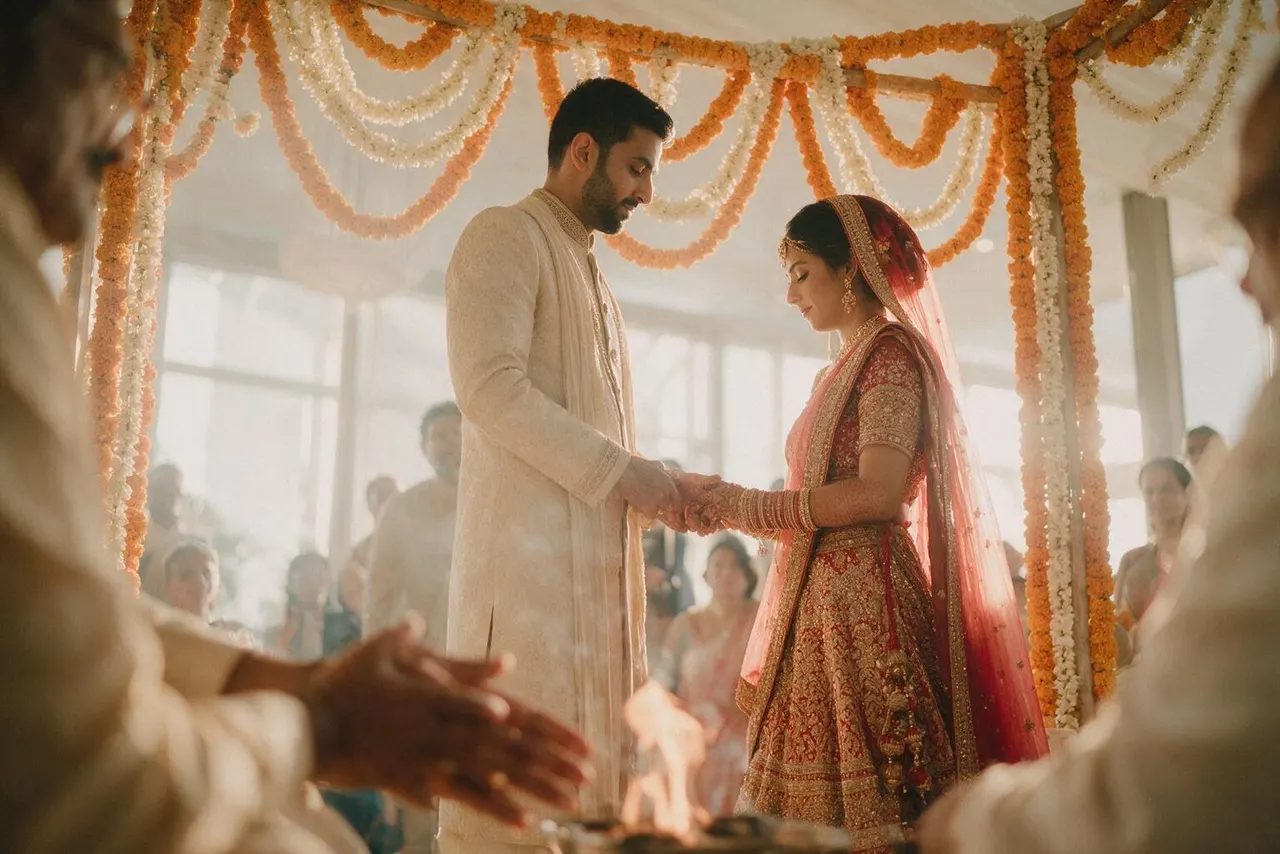
- The couple sit at the front of the hall before a ceremonial fire set up with lamps, flowers and fruits, and the rites include chanting and blessings for the couple.
- The bride wears a red pottu, a forehead decoration placed between the eyebrows.
- At the mid-point, the bride leaves the hall to change her outfit. Meanwhile, the couple’s flower garlands are passed around the guests to be blessed, and saffron rice is handed out.
- When she returns, the groom ties the thali around her neck, the couple exchange garlands as a symbol of union, and guests throw the saffron rice at the couple as a blessing while celebratory music plays.
- As a final ritual, the couple walk around the ceremonial fire three times, throwing a handful of grains into the fire each time. The ceremony usually ends with a feast for the guests.
That order is also the shot list: the couple at the fire, the garlands moving through the guests, the outfit change, the thali-tying and garland exchange, the rice shower and the rounds of the fire. Several of these happen once and briefly, so it helps to walk through the order with the priest or the family beforehand, and to know whether the ceremony is in the temple itself or in a wedding hall, since each brings different light and space.
Sikh weddings: the Anand Karaj at the gurdwara
The Sikh wedding ceremony, the Anand Karaj, is usually held at a gurdwara in the presence of the Guru Granth Sahib and centres on the four Lavan hymns, with the couple walking around the Guru Granth Sahib once for each hymn. Everyone entering a gurdwara, including photographers and videographers, covers their head and removes their shoes before entering the prayer hall.
Rules on flash and movement during the ceremony vary by gurdwara and by the officiating granthi, so ask ahead of the day what is permitted during the Anand Karaj itself. Some moments may call for photographers to stay seated or to avoid flash entirely, and it is far better to know this in advance than to find out mid-ceremony.
Christian Indian weddings
Indian Christian weddings in Singapore vary by denomination and family tradition; the marriage may be celebrated during a church service, with Indian cultural elements included in the ceremony, the reception or both. Tell your photographer what you have planned rather than assuming a single format.
Church rules on photography, such as where a photographer can stand, whether flash is permitted during the vows and whether video lighting is allowed, vary from one church to another, so confirm them with the church directly. Our guide to church wedding photography covers the service itself.
Low light and long ceremonies
Religious wedding ceremonies can last longer than a civil solemnisation, and lighting varies by venue. At some Hindu ceremonies, lamps and a ceremonial fire add to the available light; at gurdwaras and churches, check the actual lighting and photography rules in advance. Where the light is low, photographers generally rely on available light and camera settings rather than adding flash or extra lighting, especially where flash is restricted.
A longer ceremony also means a longer stretch of sustained attention from the crew, watching for specific ritual moments — a thali-tying, an exchange of garlands, a specific round of the Lavan — that may only happen once and briefly, in between longer stretches of chanting or prayer.
Family formals with large extended families
Indian weddings often involve large extended families, and formal group photographs afterwards can include many different combinations — immediate family, grandparents, each set of aunts and uncles, cousins, and close family friends considered part of the household. Asking the family in advance for a list of specific group combinations that matter to them, rather than working it out on the spot, saves time and avoids missing a pairing that the family will notice later.
Because these formals can take a meaningful amount of time with a large family, it helps to build a realistic block into the day’s schedule rather than assuming they can be done quickly between other events.
Early starts and long days
Preparation for an Indian wedding, particularly for the bride, can begin very early in the day, involving hair, makeup and draping of the saree or other attire well before the ceremony itself starts. Where a mehndi or sangeet is held the evening before, the crew and family may also be working a long stretch across two consecutive days rather than a single event.
Confirming call times and the expected length of preparation with the family in advance helps set realistic expectations for both the couple and the photography and video crew, rather than everyone estimating separately.
How coverage is usually structured across days
Because an Indian wedding can span a mehndi or sangeet, a ceremony and a reception, coverage is often structured as separate bookings or separate blocks within one package, rather than a single continuous shoot. Some families want every event covered fully; others focus coverage on the ceremony and reception and treat the mehndi or sangeet as a lighter, less formally documented event.
Discussing which events matter most to the family, and how many separate days or sessions are involved, early in the planning process makes it much easier to scope the right amount of coverage rather than adjusting the plan close to the date.
Traditions vary considerably across Singapore’s Indian communities and even between individual families, so treat the above as general context to confirm rather than a fixed script. If you would like to talk through coverage for your ceremony or reception, check your date with us, or read more about our actual-day wedding photography.